
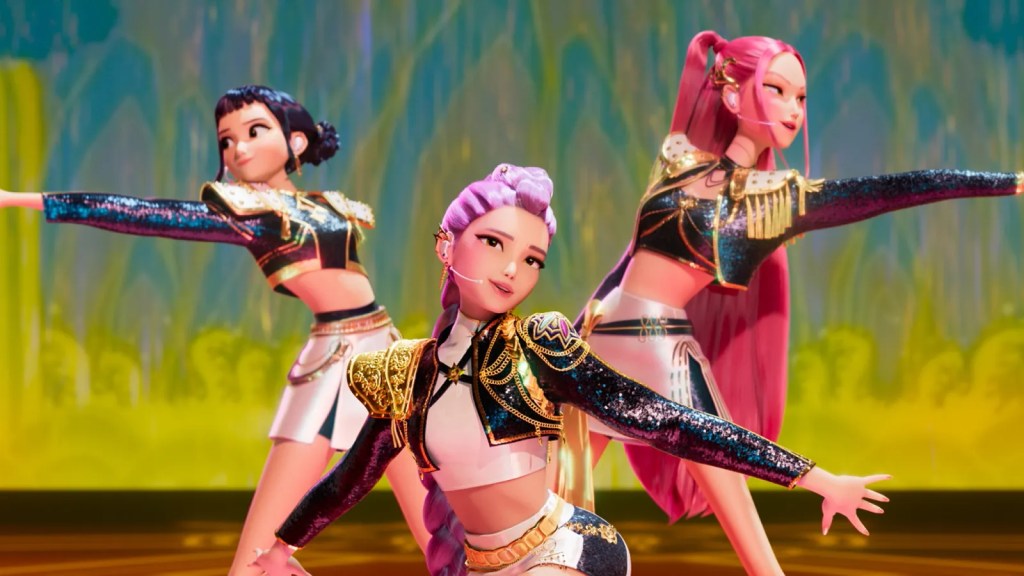
This was a much older post, as KPDH came out last year. But these were the thoughts and reflections on KPOP Demon Hunters I had as an Asian-American and an upcoming mental health professional).
I first heard of this film from someone at church, and didn’t think much about it since I don’t subscribe to Netflix (my husband does though). I also saw 1 make-up video of making someone look like Jinu on tiktok a couple of weeks after it came out, but obviously did not understand the reference. I thought the title was a bit cheesy, but my husband and I saw the trailer and thought that it would be worth watching it. At this point, I have watched it about a dozen times, know most of the songs by heart, have a sweater from the film, attended the sing-along version in theatres, put references to it as my computer background and various profile photos, and my husband also has gotten me lots of Kpop demon hunter merch for my birthday. Safe to say, I ended up really loving and obsessing over the movie, and am really proud that it had become Netflix’s #1 most viewed film in just 2 months the summer it came out, as well as having 4 songs on the billboard top 100 at the same time at one point !
Anywho, this is a post I’ve had in my drafts for a while and I wanted to share the things that stood out to me after watching the film close to about a dozen times.
That being said, if you have not watched this film, there are spoilers included ! So reader beware !
Firstly, what stood out to me is Jinu being drawn to Rumi yes perhaps romatically but also because she is a ‘demon’ who is living ‘free’. Later during the film, Jinu realizes this is something he can choose for himself too and that it is something he can do – to live free – or at least to choose freely, despite being a ‘demon’. A lot of of what controls the demons in this world is fear and shame, which no doubt are very strong motivators, but Jinu shows that he can choose not to have those emotions drive his life (or I guess his afterlife, being a ‘demon’ and all). We see Jinu get to know Rumi throughout the film and learn that she isn’t controlled by the demon king.
I think it is sincerely towards the end of the film, after Rumi and Jinu have a rupturing conversation about the shame and pain ‘demons’ live in, that Jinu is inspired by Rumi joining in on the Saja Boys’ last performance. Despite the shame that Rumi was holding about her having demon marks and concealing them, she shows up in public letting everyone see them, and she still decides to move towards good and try her best to save the day. Jinu is challenged by seeing Rumi live and move forward doing good despite her shame, and I think that is what eventually allows Jinu to choose freedom for himself, too, even if it means (potentially) giving up his own existence.
Rumi’s ‘biological’ makeup has been something I pondered as well, being half human, half-demon. There is an aspect of acknowledging that shame exists to overcome it rather than accepting what shame is saying about your personhood (which is what the demon king was constantly doing to his demon minions). The reality is, there is some truth in shame, which is why it feels credible and compelling. But the reality is also that shame is just a half-truth and it is actually the whole truth that frees. I know perhaps this idea I’m about to share is an oversimplification, but with Rumi’s human heritage representing what is ‘good’ and her ‘demonic’ heritage representing what is ‘bad’ – I think this is what makes her able to be unaffected by the demon king as it is part of her very makeup to integrate pain (which can be further exacerbated by being described as ‘bad’), and her goodness.
Another thing that has stood out to me from this film is the song lyrics. One part from the Saja Boys’ last performance stands out to me where they say “Thank you for the pain cause it got me going viral”. Honestly, I cannot help but think of advertising and how capitalism has come to function in general. A lot of what keeps capitalism running is the illusion of lack and scarcity, and that we are missing something and that we are not getting enough of something. Sadly it truly is pain that gets things ‘going viral’ – but also thinking of these lyrics is coinciding with a time in my life where I am trying to find and learn my own ways to contribute less and less into consumerist capitalism as reasonably possible.
The last thing I wanted to share that I thought was quite beautiful about this film is that the honmoon isn’t only created by Huntrix, it’s that the honmoon requires everyone. In the film, the honmoon is this spiritual shield that protects the human world from the demons. To me, Huntrix’s special ability is to activate and strengthen the honmoon, which they are a part of as well, but the honmoon already exists and it is all humans hold the honmoon. If the demonic world represents shame, I find it beautiful that the creators decided that all of humanity holds the honmoon. To me, I thought of it as solidarity and compassion (knowing this as the opposite of shame) countering the effects of shame, which frequently lead to psychological/physical self-harm and loneliness.
Ultimately, this film gives the message that shame begets shame, but it also shows that the opposite holds true – that compassion begets compassion, especially self-compassion. If you have not watched this film, you may not see these themes that I share right away. Regardless if you do or don’t, I still highly recommend this film storyline-wise as well as it it is also just very entertaining !




Leave a Reply